
In previous posts here, I described using Clifford algebras for representing points and rotations. I was never very satisfied with this because the translations were still tacked on rather than incorporated in the algebra. To represent geometric objects, you need to track two Clifford multivectors: one for the orientation and another for the offset.
About two weeks ago, I found David Hestenes’s paper Old Wine in New Bottles: A new algebraic framework for computational geometry. In that paper, he describes a way to use Clifford Algebras to unify the representation of points, lines, planes, hyperplanes, circles, spheres, hyperspheres, etc. This was a big bonus. By using a projective basis, we can unify the orientation and offset. By using a null basis, we can bring in lines, planes, hyperplanes, circles, spheres, and hyperspheres.
The null basis ends up giving you a point at infinity. Every line goes through the point at infinity. None of the circles do. But, if you think of a line as a really, really big circle that goes through infinity, now you have unified lines and circles. Circles and lines are both defined by three points in the plane. (Technically, you can define a line with any three collinear points, but then you need to craft a point collinear to the other two. The point at infinity is collinear with every line. Further, such things could be seen as flattened circles having finite extent (diameter equal to the distance between the furthest apart of the three points) rather than an infinite line.)
So, I need to use Clifford algebras with a projective and null basis. All of the playing I previously did with Clifford algebras was using an orthonormal basis.
What is a basis?
To make a Clifford algebra, one starts with a vector space. A vector space has a field of scalars (real numbers, usually) and vectors. You can multiply any vector by a scalar to get another vector. And, if 





You can add together any two vectors to get another vector. Further, this addition is completely compatible with the scalar multiplication so that 



Every vector space has a basis (though some have an infinite basis). A basis is a minimal subset of the vectors such that every vector vector can be written as the sum of multiples of the basis vectors. So, if the whole basis is 
Okay, but what is an orthonormal basis?
You need more than just a vector space to make a Clifford algebra. You need either a quadratic form or a dot-product defined on the vectors.
A quadratic form on a vector is a function 

A dot product is a function 



From any dot product, you can make a quadratic form by saying 


So, let’s say we have a dot product on our vector space. What happens when we take the dot product on pairs of our basis vectors? If 
We say a basis element 
An orthonormal basis is a basis that’s both an orthogonal basis and a normal basis.
You can represent any dot product as a symmetric matrix 


If your orthogonal basis is not normalized, you can (almost always) normalize the basis vectors where 

So, as long as you can divide by square roots in whatever numbers system you chose for your scalars, then you can find an orthonormal basis. That means that 

You can also re-order your basis set so that all of the 


What about Projective and Null?
I mentioned at the outset that the Hestenes paper uses a projective basis that’s also a null basis. If you’ve done any geometry in computers before you have probably bumped into projective coordinates. If you have a 3d-vector ![[x,y,z]^T](http://l.wordpress.com/latex.php?latex=%5Bx%2Cy%2Cz%5D%5ET&bg=FFFFCC&fg=000000&s=0 "[x,y,z]^T")
![[x,y,z,1]^T](http://l.wordpress.com/latex.php?latex=%5Bx%2Cy%2Cz%2C1%5D%5ET&bg=FFFFCC&fg=000000&s=0 "[x,y,z,1]^T")
What about a null basis though? With a null basis, 




Clifford Algebras with an Orthonormal Basis
Once you have a vector space and a quadratic form or dot product, then you make a Clifford algebra by defining a way to multiply vectors together. For Clifford algebras, we insist that when we multiply a vector
Let’s look at what happens when we have two vectors 


Remember, now, the connection between the quadratic form 



Because 


If 


Now, given an arbitrary vector, we can express it as a sum of multiples of the basis vectors: 


So, suppose there were two vectors in our orthonormal basis 





We still don’t know what 
What happens if we multiply 






What happens if we multiply 

So, that’s as big as our tent is going to get with only two vectors in our orthonormal basis.
Our Clifford algebra then has elements composed of some multiple of the scalar 


You can rework any term 


What Happens When You Don’t Have An Orthonormal Basis?
The Hestenes paper doesn’t use an orthonormal basis. I’d never played with Clifford algebras outside of one. It took me about two weeks of scrounging through text books and information about something called the contraction product and the definitions of Clifford algebras in terms of dot-products plus something called the outer product (which gives geometric meaning to our new
things like
I learned a great deal about how to multiply vectors, but I didn’t feel that much closer to being able to multiply 

extend by linearity
.
There’s a whole lot of extending by linearity
in math. In some cases, I feel like extending by linearity leaves me running in circles. (To go with the theme, sometimes I’m even running in a really big circle through the point at infinity.) We did a bit of extending by linearity above when we went from 

Finally, something clicked for me enough to figure out how to multiply
If we don’t have an orthogonal basis, then the best we can do is 




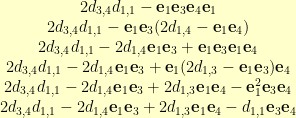
Whew. Now, to get that into code.
26 SLOC
In the end, I ended up with this 26 SLOC function that takes in a matrix dots to represent the dot product and some number of ordered lists of subscripts and returns a list of scalars where the scalar in spot 


(basis-multiply dots '(1 4) '(3) '(1)), the zeroth term in the result would be 


From this, I will be able to build a function that multiplies arbitrary elements of the Clifford algebra. Getting to this point was the hard part for me. It is 26 SLOC that took me several weeks of study to figure out how to do on paper and about six hours of thinking to figure out how to do in code.
(let ((len (expt 2 (array-dimension dots 0))))
(labels ((mul (&rest xs)
(let ((xs (combine-adjacent (remove nil xs))))
(cond
((null xs)
(vec len 0))
((null (rest xs))
(vec len (from-bits (first xs))))
(t
(destructuring-bind (x y . xs) xs
(let ((a (first (last x)))
(b (first y))
(x (butlast x))
(y (rest y)))
(if (= a b)
(combine-like x a y xs)
(swap-ab x a b y xs))))))))
(dot (a b)
(aref dots (1- a) (1- b)))
(combine-like (x a y xs)
;; X e1 e1 Y ... = (e1.e1) X Y ...
(vs (dot a a) (apply #'mul x y xs)))
(swap-ab (x a b y xs)
;; X e2 e1 Y ... = 2(e1.e2) X Y ... - X e1 e2 Y ...
(v- (vs (* 2 (dot a b)) (apply #'mul x xs))
(apply #'mul x (list b a) y xs))))
(apply #'mul xs))))
I had one false start on the above code where I accidentally confounded the lists that I was using as input with the lists that I was generating as output. I had to step back and get my code to push all of the work down the call stack while rolling out the recursion and only creating new vectors during the base cases of the recursion and only doing vector subtractions while unrolling the recursion.
There are also 31 SLOC involved in the combine-adjacent function (which takes a list like ((1 2 3) nil (4 5) (3)) and removes the nils then concatenates consecutive parts that are in order already to get ((1 2 3 4 5) (3))), the vec function (which makes a vector of a given length with a non-zero coefficient in a given location), the from-bits function (which turns a list of integers into a number with the bit 
vs and v- (which, respectively, scale a list of numbers by a factor and element-wise subtract two lists).
The 31 supporting SLOC were easy though. The 26 SLOC shown above represent the largest thought-to-code ratio of any code that I’ve ever written.
WO0T!!!t!1! or something!
Now, to Zig this SLOC for Great Justice!
 as
as  . It shouldn’t surprise you then to find we’re going to represent three-dimensional coordinates
  as
as  .
. and
and  . Similarly, we will have
  . In the two-dimesional case, we showed that
  . By the same logic as the two-dimensional case, we also find that
  and
and  . We could potentially also end up multiplying
  ,
,  , and
, and  all together. This isn’t going to be equal to any combination of the other things we’ve seen so we’ll just leave it written
  .
. ) that has the same property that its square is negative one?
 . But, nothing you come up with makes any sense.
 which is equal to
  , everything works out. You get so excited, that you carve your equations into a stone bridge over the canal:
 , I multiplied on the left by an element representing a rotation of angle
  and multiplied on the right by an element representing a rotation of angle
  .
. radians). This means our total rotation is going to be a half turn (180 degrees,
  radians).
 and so
  . Let’s just look at what it does to our unit vectors
  and on the right by
  .
. . Similarly, for
  .
. -coordinate of something if you rotate things parallel to the
  -plane? It remains unchanged.
 ? We would end up with
  . We’ve ended up scaling
  . Every time we transpose elements with different subscripts, we flip the sign. Every time we get two elements next to each other with the same subscript, they cancel out. So, switching the
  . From there, we can switch the first two elements to get
  which is just
  . We can switch the
  which is just